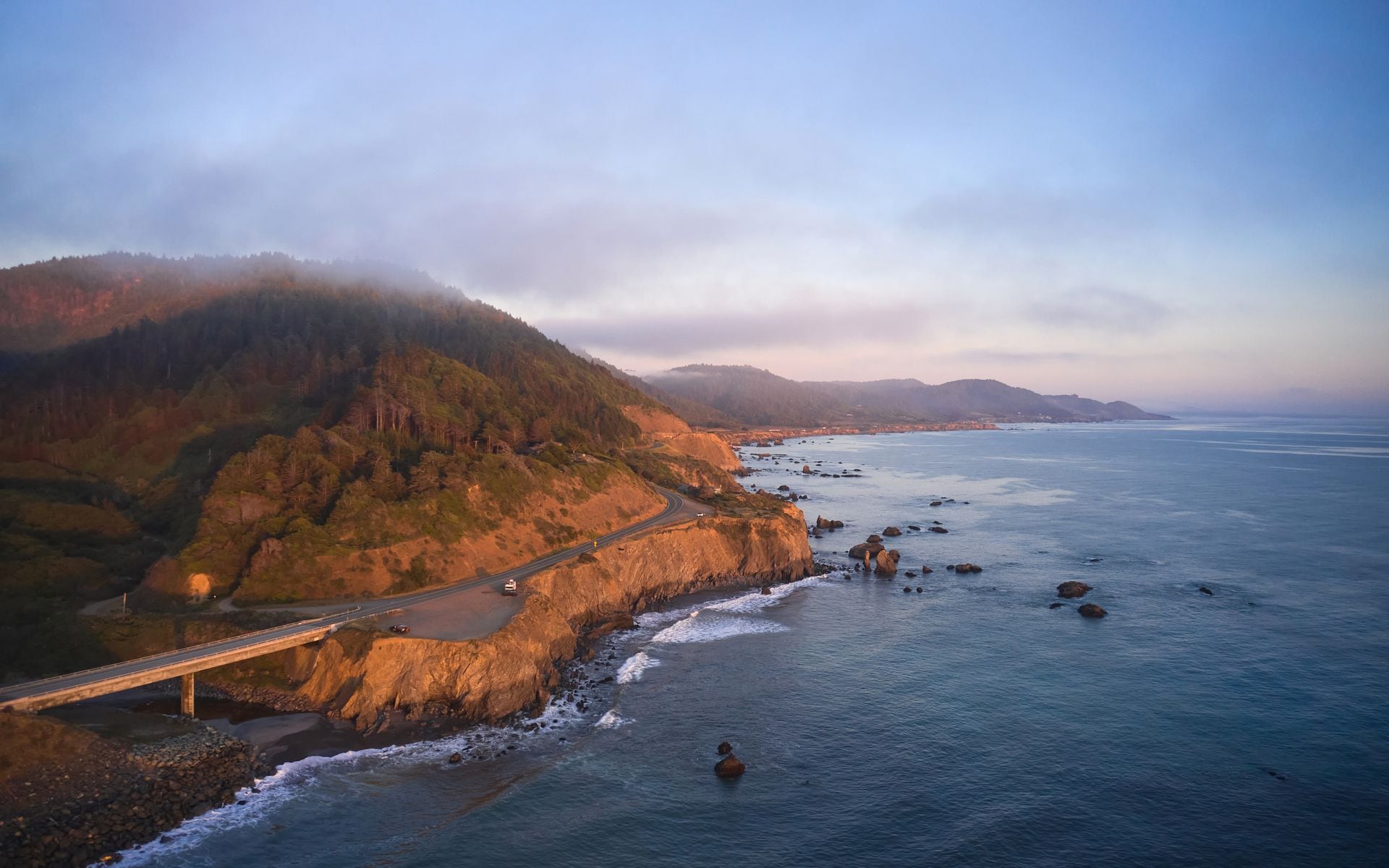
What Defines the North Coast
The North Coast is the stretch of California shoreline running from just above San Francisco all the way to the Oregon border, and it is the opposite of the Southern California beach experience. Here the water is cold, the summers are foggy and cool, and the crowds thin out the farther north you go. What you trade the warmth for is space: rugged headlands, redwood forests running right down to the sea, and small towns where the pace slows to a crawl. It is one of the quietest corners in the whole California travel guide.
US-101 is the spine of the region, sometimes hugging the coast and sometimes cutting inland through the redwoods. The two anchors are Mendocino, a preserved 19th-century village on the bluffs about three hours north of the Bay, and the Redwood National and State Parks at the far north end, home to the tallest trees on the planet. In between lie Humboldt County, the Avenue of the Giants, and the working port town of Eureka.
This is a region defined by fog and distance. Summer mornings on the North Coast are often gray and cool, burning off to sun by afternoon, and the drives between highlights are longer than the map suggests because the road winds. Come knowing that the payoff is quiet and scenery, not beach weather.
Main Bases and Towns
Mendocino is the classic base for the southern half of the region. The village itself is tiny, all weathered wood and water towers on a headland, with inns, cafes, and galleries within walking distance. Just south, Mendocino Headlands State Park wraps the town in bluff-top trails, and a few miles up the coast MacKerricher State Park near Fort Bragg has tide pools, a harbor-seal haul-out, and a long beach. From Fort Bragg you can also ride the Skunk Train, a historic railway that runs inland through the redwoods along Pudding Creek.
Farther north, Eureka and Arcata are the practical bases for the redwood parks and Humboldt County. Eureka has a walkable Victorian old town and the widest range of services in the far north; the Eureka Casino Resort area gives you a full-service lodging option before you push into the parks. This is your last real supply stop before the northernmost redwoods.
For a change of pace off the coast, the Mendocino Coast Botanical Gardens run right down to the ocean bluffs south of Fort Bragg and make an easy, gentle half-day. Wherever you base, book ahead in summer and fall; the North Coast has fewer rooms than the south, and the good inns fill. For the statewide picture, see where to stay in California.
Top Places to Prioritize
The redwoods are the reason most people make this drive, and they earn it. In the northern Redwood National and State Parks, walk the Lady Bird Johnson Grove or Stout Grove for the classic cathedral of 300-foot trees, and drive the Newton B. Drury Scenic Parkway through old-growth forest. Farther south off US-101, the Avenue of the Giants in Humboldt Redwoods State Park is a 31-mile drive under the canopy that you can do slowly with plenty of short-trail stops.
Mendocino is the other pillar and the more social one. Spend a day walking the village and the headlands trails, poke through the galleries, and time a sunset on the bluffs. The stretch of coast from Mendocino up through Fort Bragg to MacKerricher is the scenic heart of the southern North Coast, and you can string it into an easy day of short stops.
If you have time, add the wildlife. The North Coast is prime whale-watching territory in migration season, and the tide pools and seal haul-outs at MacKerricher and along the Mendocino headlands give you close-up marine life without a boat. For a warmer, sandier alternative when the fog wins, compare the best beaches in California down south.
When to Go and How Long
The best months are late spring through fall, roughly May through October. Summer brings the reliable pattern of foggy mornings and sunny afternoons, and it is the safest bet for the redwood drives and coastal hikes. September and October often deliver the clearest, warmest coastal weather of the year, after the summer fog eases and before the winter rains. Winter, November through March, is wet and moody, with the heaviest rain in the state falling up here; it has its own quiet appeal but expect gray skies and swollen rivers.
For length, give the region at least two to three days. A common route is one night in Mendocino for the village and headlands, then push north for a night near Eureka to do the big redwood parks. If you only have a day from the Bay, focus on Mendocino and the nearer coast rather than trying to reach the northernmost redwoods, which are a long haul.
The mistake first-timers make is underestimating the drive. The North Coast is not a quick side trip from San Francisco; it is a destination in its own right that needs a couple of days to reach and enjoy. Build it in properly rather than trying to bolt it onto a packed itinerary.
Getting There and Around
You drive here, and you should plan for slow roads. From San Francisco, Mendocino is about a three-to-three-and-a-half-hour drive north, mostly on US-101 with a winding stretch of Highway 128 or Highway 1 to reach the coast. The northern redwood parks are much farther: roughly five to six hours from San Francisco, around 330 miles, so they really call for an overnight rather than a day trip. There is a small regional airport near Eureka (ACV) if you want to skip the long drive north, but most visitors come by car.
Once you are up here, US-101 does most of the work, with Highway 1 branching off for the coastal sections around Mendocino before the two roads rejoin. The coastal road is beautiful and slow, full of curves and one-lane bridges, so add time. Fill your tank before long stretches; services thin out between towns in the far north.
The North Coast pairs naturally with a Bay Area trip or as the northern leg of a longer California coast drive. Just respect the distances: this is the part of the state where the driving is the experience, not an inconvenience, and rushing it defeats the point. Give it the days it needs and it rewards you with the quietest, greenest coast in California.
Frequently asked questions
How far is the North Coast from San Francisco?
Mendocino is about three to three-and-a-half hours north of San Francisco by car. The northern Redwood National and State Parks are much farther, roughly five to six hours (around 330 miles), so they really need an overnight rather than a day trip. There is a small regional airport near Eureka (ACV) if you want to skip the long drive.
When is the best time to visit the North Coast?
Late spring through fall, roughly May through October. Summer brings foggy mornings that burn off to sunny afternoons, and September and October often deliver the clearest, warmest coastal weather of the year. Winter (November to March) is wet and moody, with the heaviest rain in the state falling here.
How many days do you need for the North Coast?
At least two to three days. A good route is one night in Mendocino for the village and headlands, then north for a night near Eureka to see the big redwood parks. With only a day from the Bay, focus on Mendocino and the nearer coast rather than pushing for the northernmost redwoods.
Is the North Coast good for beach weather?
Not in the Southern California sense. The water is cold and summer mornings are foggy and cool. You come here for scenery, redwoods, and quiet, not for swimming and sunbathing. If you want warm sand, head to the beaches down south instead and treat the North Coast as a cool-weather scenic trip.
What are the top things to do on the North Coast?
Walk the old-growth redwood groves in the northern parks and drive the Avenue of the Giants, explore the historic village and bluff trails at Mendocino, ride the Skunk Train from Fort Bragg, and watch wildlife at MacKerricher State Park's tide pools and seal haul-out. Whale-watching is strong here in migration season.