What to Expect
Mammoth Lakes is a full-on mountain town in the Eastern Sierra, part of California's High Sierra region and reached almost entirely by US-395, the two-lane highway that runs up the dry eastern side of the range. That geography defines the trip. You are on the rain-shadow side of the Sierra, so the light is sharp, the air is thin, and the snow that piles up on Mammoth Mountain often lingers into June and July. The base village sits at nearly 8,000 feet and the mountain tops out at 11,053, high enough that first-time visitors coming from sea level should take the altitude seriously for a day.
The town itself is compact and walkable in the core, built around skiing but busy year-round. In winter it is one of the biggest ski destinations in the state. In summer it flips into a base camp for the Mammoth Lakes Basin, the John Muir and Ansel Adams wilderness areas, and day trips to nearby Devils Postpile National Monument. Because Mammoth is a four-to-five-hour drive from the major population centers, weekends and holidays draw crowds, but midweek and shoulder seasons stay calm.
Prices track a resort town. Peak ski weeks and holiday weekends run high on lodging, and the Village at Mammoth fills first. Summer is more forgiving on rates, and the payoff is a string of glacial lakes, granite peaks, and hot springs within a short drive. If you are weighing where to ski in the state, compare it against the Tahoe resorts on our roundup of the best ski resorts in California.
What to Do
In winter, Mammoth Mountain is the whole story. The Mammoth Mountain Ski Area spreads more than 3,500 acres across 28 lifts, with terrain for every level and a long fall-line pitch off the top for advanced skiers. It routinely reports one of the deepest snowpacks in California, which is why the season stretches from November well into spring, and in big years into summer. If you are new to the sport or traveling with a mixed-ability group, the resort's ski and snowboard school is the easiest way in. For the full picture of the sport across the state, see our guide to skiing and snowboarding in California.
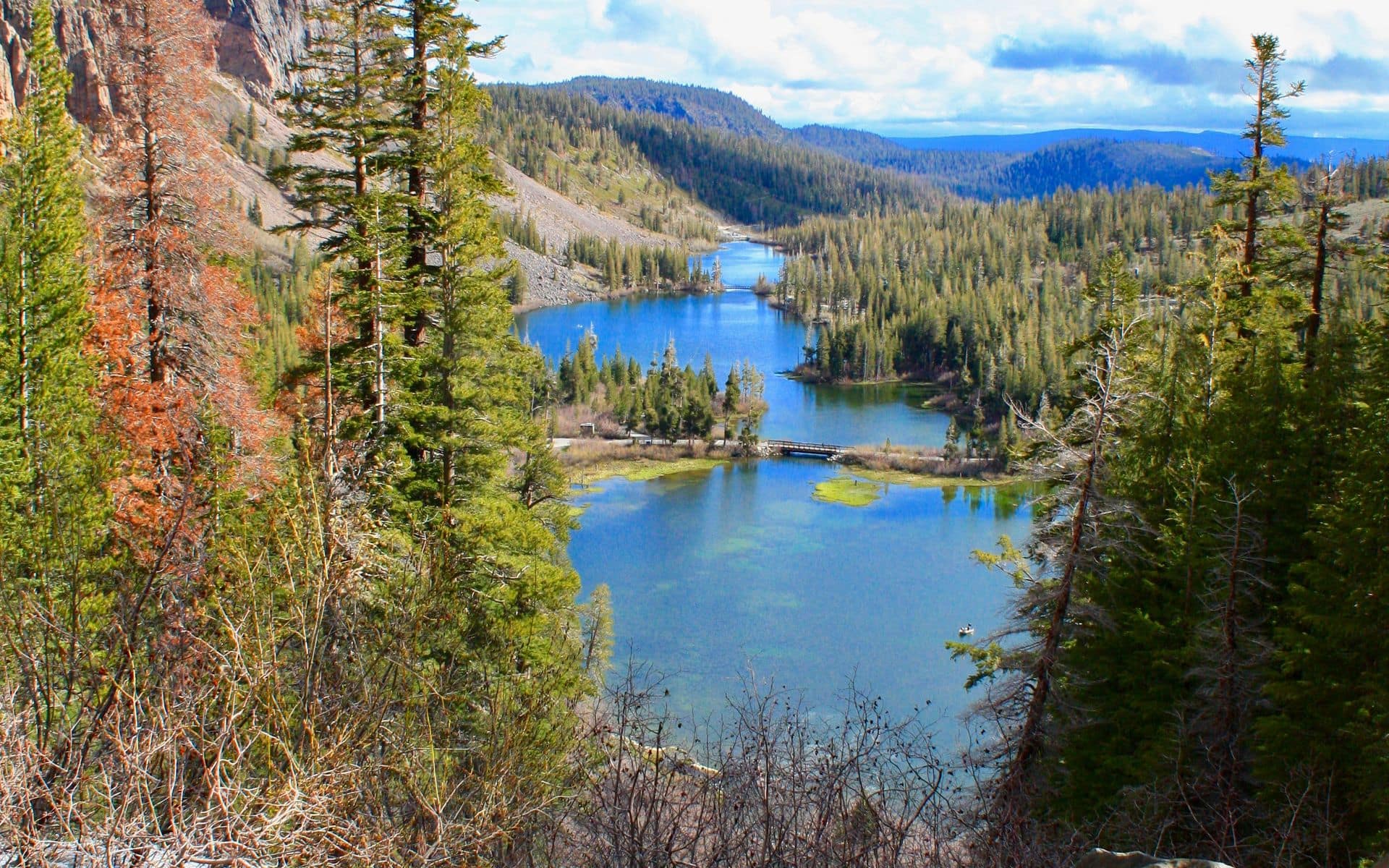
In summer the same mountain becomes the Mammoth Bike Park, with lift-served downhill trails and a network of cross-country routes fanning out through the forest. The Mammoth Lakes Basin is the summer heart of it: Lake Mary, Twin Lakes, Lake George, and Horseshoe Lake sit within a few minutes of town, all with trout fishing, kayak and paddleboard rentals, and trailheads. The hike from Lake George up to Crystal Lake and TJ Lake is a short, steep payoff, and Duck Pass climbs past a chain of lakes into the wilderness for stronger hikers.
Two nearby sights are worth the effort. Devils Postpile National Monument, reached by a seasonal shuttle from the Mammoth Mountain Main Lodge in summer, protects a wall of hexagonal basalt columns and the trail down to Rainbow Falls on the San Joaquin River. Convict Lake, about 15 minutes south off US-395, is a deep, cliff-ringed lake with an easy 3-mile shoreline loop and some of the best light in the Eastern Sierra. Hot Creek Geological Site, closer to the airport, has steaming vents and blue pools along a river canyon.
Getting There
The standard approach is US-395. From Los Angeles it is about 307 miles and 5 to 5.5 hours north through the Owens Valley, one of the great drives in California with the Sierra crest on your left the entire way. From the Reno-Tahoe area it is roughly 165 miles and about 3 hours south on US-395. There is no fast way in from the coast, and that is the point: Mammoth stays remote because getting there takes commitment.
From the San Francisco Bay Area the route depends entirely on the season. In summer and early fall you can cross the Sierra directly on Tioga Road (CA-120) through Yosemite National Park, a spectacular high-country crossing that drops you onto US-395 just north of the June Lake Loop. Tioga Road is closed by snow from roughly November until late May or June, so in winter that door is shut and you have to go the long way around, either south through the Central Valley and up US-395 or over Donner Summit to Reno and down. Always check the Tioga Pass status before you plan a Bay Area trip.
Mammoth Yosemite Airport (MMH), a few miles east of town, takes seasonal commercial flights, typically from Los Angeles and San Francisco in ski season and summer on carriers like Advanced Air and United. Flying in saves the long drive but schedules are weather-dependent and cancellations happen, so build in a buffer. Whatever way you arrive, you want a car once you are there, and in winter you must carry chains and know how to use them.
Best Time to Go
For skiing and riding, the window runs from roughly late November through April, with the deepest, most reliable snow usually landing from January into March. Mammoth's elevation is its advantage: while lower resorts thaw out, Mammoth often keeps lifts spinning into May, Memorial Day, and in heavy-snow years all the way to July 4th. Holiday weeks and Presidents' Day weekend are the busiest and priciest; midweek in January or early April is the sweet spot for value and open runs.
For hiking, fishing, and mountain biking, aim for July through September, once the basin roads and Tioga Road have opened and the snow has cleared the trails. High-country lakes stay cold but the days are warm and dry, and the wildflowers in Ansel Adams Wilderness peak in mid-summer. Fall brings the aspen turn along US-395 and the June Lake Loop, usually late September into mid-October, one of the best foliage shows in the West.
The shoulder seasons, May and late October into November, are quieter but awkward: the mountain may be closing or not yet open, and many trails are either muddy with snowmelt or already getting early snow. If your dates are flexible, they can be cheap and calm, but check what is open before you commit.
Where to Stay and Eat
The most convenient base is the Village at Mammoth, the pedestrian core with the gondola to Canyon Lodge, restaurants, and rental shops steps from your door. The Village Lodge sits right in it, with condo-style units that suit families and groups. For something quieter and closer to the lakes, Tamarack Lodge and Resort on Twin Lakes has cabins and a lodge with cross-country skiing in winter and canoeing in summer, plus one of the better dining rooms in town at the Lakefront Restaurant.
For a memorable night away from the ski crowds, Convict Lake Resort, about 15 minutes south, has cabins on the water and a restaurant with a serious wine list that draws people up from town on its own. Book any of these well ahead for holiday weeks and powder weekends, when Mammoth sells out. Rates ease considerably from mid-week and in the summer season.
In town, the food scene is bigger than the population suggests, running from breakfast spots and burger joints to sit-down dinners. The Village at Mammoth clusters several options in one walkable block, which is handy after a day on the hill when you do not want to get back in the car. Pack layers regardless of season: even July nights at 8,000 feet drop toward freezing.
Good to Know
Altitude is the first thing to plan for. Coming from sea level to nearly 8,000 feet, you may feel short of breath or headachy the first day. Drink more water than you think you need, go easy on alcohol the first night, and give yourself a mellow first day before a big hike or ski day. The sun is strong at elevation, so sunscreen matters even in winter.
Winter driving on US-395 and the local roads is real mountain driving. Carry chains, keep your tank above half, and check Caltrans road conditions before you set out, especially over the passes. Cell coverage is spotty once you leave the highway corridor, so download maps offline. In summer, afternoon thunderstorms can build fast over the peaks, so start high-country hikes early and be off exposed ridges by early afternoon.
Mammoth pairs naturally with a Yosemite trip in summer via Tioga Road, and with Lake Tahoe as a two-stop Sierra ski trip in winter. If you are building a broader mountain itinerary, our High Sierra region guide lays out how the pieces connect and how long the drives really take.
Frequently asked questions
How long is the drive to Mammoth Lakes from Los Angeles?
About 307 miles and 5 to 5.5 hours north on US-395 through the Owens Valley, without traffic or weather delays. It is one of the best drives in California, but there is no shortcut, so leave early on peak weekends when US-395 backs up near the resort towns.
Can you drive from Mammoth to Yosemite?
Yes, in summer and early fall, via Tioga Road (CA-120), which crosses the Sierra crest into Yosemite's high country. It is closed by snow from roughly November until late May or June. In winter there is no direct route, and you have to go the long way around the range.
When does Mammoth Mountain close for the season?
It varies with the snowpack, but Mammoth's high elevation lets it stay open far longer than most California resorts, commonly into May and often to Memorial Day. In heavy-snow years it has run lifts into July. Check the resort's current-season closing date before planning a late-spring trip.
Is Mammoth Lakes worth visiting in summer?
Very much so. From July through September the Mammoth Lakes Basin, Devils Postpile, Convict Lake, and the surrounding wilderness offer some of the best alpine hiking, fishing, and mountain biking in the state, with lower lodging rates than ski season and far smaller crowds.
Do you need a car in Mammoth Lakes?
Yes. The town runs a free seasonal shuttle around the village and to the mountain, but to reach Convict Lake, Hot Creek, the June Lake Loop, and the trailheads you want your own vehicle. In winter, carry tire chains and know how to fit them.