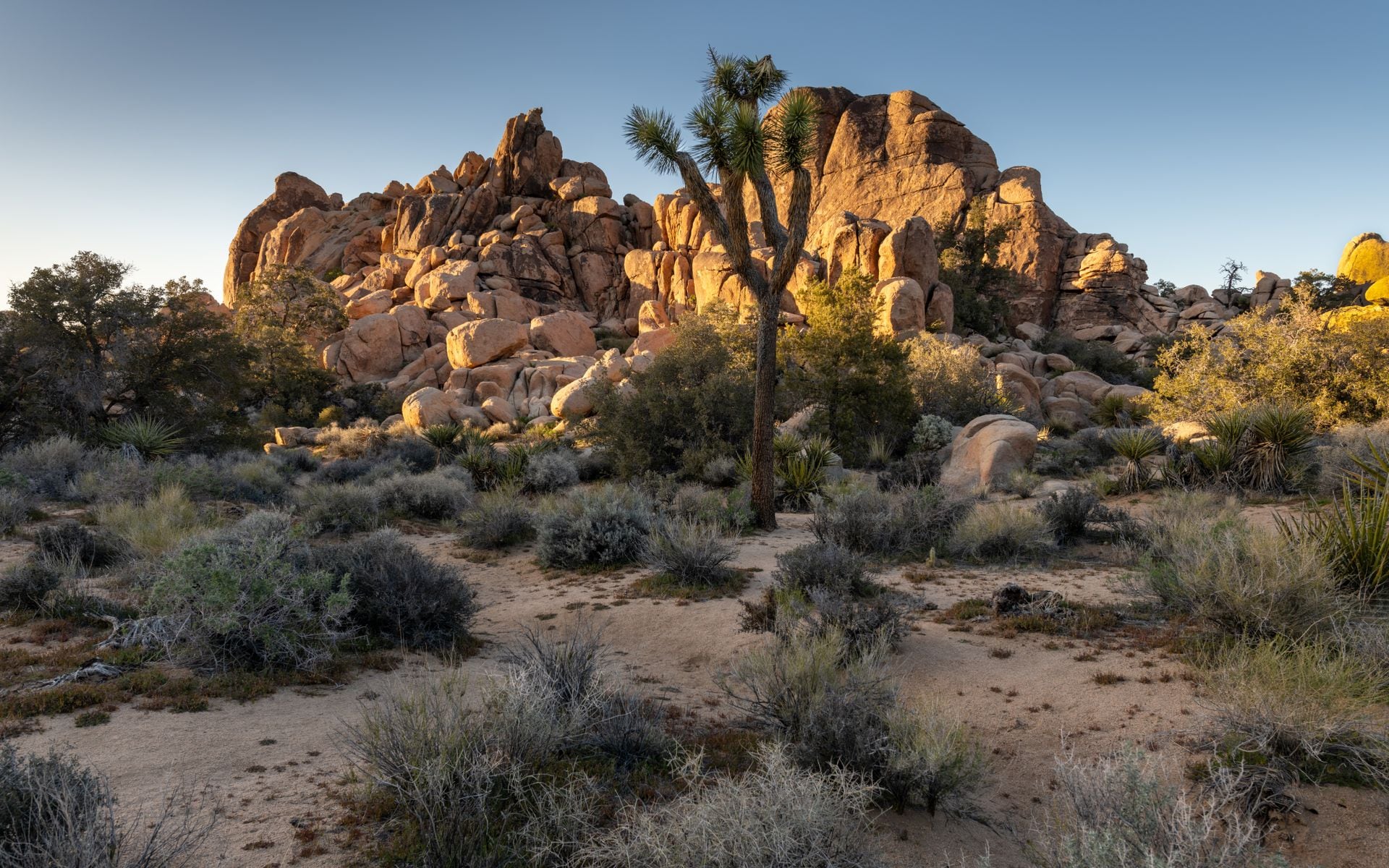
Joshua Tree works well as a weekend because the park is compact enough to see the highlights in two days but strange enough that you will want the full 48 hours. It sits about 2.5 hours east of Los Angeles and 45 minutes north of Palm Springs, where two deserts meet: the higher Mojave with its twisted Joshua trees and granite piles, and the lower Colorado desert of ocotillo and cholla. This guide lays out a real two-day plan, tells you when to come, and points you to actual places to sleep and eat. For the full park breakdown, see the Joshua Tree National Park page.
When to Go and What It Costs
Come October through April. Daytime highs in that window run roughly 60 to 85 degrees, and nights drop into the 40s, so pack layers. May through September is a different animal: highs regularly clear 100 and can top 110 in July and August, which turns midday hiking into a genuine safety problem. If you can only travel in summer, hike at dawn, carry more water than you think you need (a gallon per person per day), and treat the afternoon as pool time back at the hotel. Spring wildflower season, usually March into April, is the busiest and best stretch, so book lodging early. For the wider seasonal picture across the state, check the best time to visit California.
The entrance fee is $30 per vehicle, good for seven days. An America the Beautiful annual pass at $80 covers it and every other national park, which pays off fast if you are also doing Death Valley or the Sierra parks on the same trip. There are three entrances: the West Entrance at the town of Joshua Tree, the North Entrance at Twentynine Palms, and the South Entrance off Interstate 10 near Cottonwood. The West Entrance is the most scenic and the most backed up. On weekend mornings in spring the line can run 30 to 45 minutes, so aim to be there before 8 a.m. or enter through the North Entrance instead. Joshua Tree does not run a timed-entry reservation system the way Yosemite and Arches do, so you can show up any time, but the West Entrance bottleneck is real and the only fix is arriving early.
If you want to sleep inside the park, book a campground. There are nine, and none have hookups or showers, but the setting among the boulders is the reason to do it. Jumbo Rocks, Indian Cove, Black Rock, and Cottonwood take reservations on recreation.gov and go months ahead for spring weekends; Hidden Valley, Ryan, White Tank, and Belle are first-come, first-served and fill by Friday afternoon in season. Camping runs about $20 to $25 a night. Only Black Rock and Cottonwood have potable water, so at the others you haul in everything you drink and cook with. Nights are cold well into spring, so bring a real sleeping bag, not a summer one.
Day One: The Mojave Core
Enter at the West Entrance and stop first at Hidden Valley, a one-mile loop that threads through a bowl of boulders that once hid cattle rustlers. It is the best short introduction to the park’s rock and plant life. From there drive to Barker Dam, another easy 1.3-mile loop that passes a small reservoir and a panel of Native American petroglyphs. Kids handle both of these fine.
Mid-morning, drive up to Keys View. It is a short spur off the main road and delivers the biggest long view in the park: the Coachella Valley, the San Andreas Fault line running across the floor, and Mount San Jacinto rising over 10,000 feet on the far side. On clear winter days you can see the Salton Sea. Go early, because afternoon haze flattens it.
For the afternoon, if you have the legs, climb Ryan Mountain. It is 3 miles round trip with about 1,000 feet of gain and rewards you with a 360-degree view of the whole Mojave section. If that is too much, the Cap Rock nature loop nearby is flat and quick. End the day at Cholla Cactus Garden down in the Pinto Basin, about 20 minutes south, where a dense stand of teddy bear cholla lights up when the low sun hits it. Do not touch the cholla; the spines are worse than they look.
If you have interest in the human history here, the ranger-led Keys Ranch tour is worth reserving. It walks you through the homestead Bill and Frances Keys built and worked from 1917 into the 1960s, complete with the schoolhouse, workshop, and rusting cars left where they died. Tickets run about $10 and sell out on recreation.gov, so grab one before you arrive. Geology Tour Road, an 18-mile dirt loop off the main park road, is the other worthwhile detour, but it needs high clearance and ideally four-wheel drive for the back half, so do not take a rental sedan past the turnaround point at marker nine.
Day Two: Rocks, Sunrise, and the West Side Towns
Start early with sunrise near Skull Rock or the Arch Rock trail, an easy half-mile loop off Pinto Basin Road that frames the sky through a granite arch. Rock scramblers should spend the morning at Jumbo Rocks or Wonderland of Rocks, where the boulder piles turn the desert into a natural playground. Joshua Tree is one of the top rock-climbing destinations in the country, and outfitters like Cliffhanger Guides and Joshua Tree Uprising run half-day beginner climbs if you want to try it with ropes and instruction.
Spend the back half of day two in the towns just outside the park. The village of Joshua Tree has galleries and the Joshua Tree Saloon. Fifteen minutes northwest in Pioneertown, Pappy & Harriet’s is a former movie-set roadhouse that now serves barbecue and books real touring bands; reserve a table on weekends because it fills. In town, Crossroads Cafe is the reliable breakfast and lunch stop, Natural Sisters Cafe handles the vegetarian and smoothie crowd, and La Copine out in Flamingo Heights is worth the drive for dinner if you plan ahead. Over in Twentynine Palms, the Campbell Hill Bakery does the morning pastry run and the 29 Palms Inn restaurant serves a solid dinner in the adobe bungalows around the Oasis of Mara.
Two off-park detours reward the curious. The Noah Purifoy Outdoor Desert Art Museum, a ten-acre field of assemblage sculpture built from salvage, sits north of the town of Joshua Tree and is free to walk. Further out in Landers, the Integratron runs 60-minute sound baths inside a domed wooden structure built in the 1950s; book those weeks ahead because they sell out. Neither is a national-park thing, but both are the kind of high-desert oddity that makes people fall for this corner of California.
Stargazing After Dark
Joshua Tree was named an International Dark Sky Park in 2017, and the night sky is a headline attraction, not a footnote. Once the sun drops and the day-trippers clear out, the Milky Way is visible to the naked eye across most of the park. The darkest, easiest spots to pull over are Cap Rock, the Cholla Cactus Garden lot, and anywhere along Pinto Basin Road away from the entrance glow. Bring a red-filter flashlight so you do not wreck your night vision, and check the moon phase before you go, because a full moon washes out the stars almost as badly as a city would.
If you want structure, the Sky’s the Limit Observatory and Nature Center just outside the North Entrance in Twentynine Palms runs free public star parties on many Saturday nights, weather permitting. Fall is the calmest, clearest stretch for this, and the annual Night Sky Festival brings telescopes and rangers into the park proper. Dress warmer than you think you need to; the desert dumps its heat the moment the sun sets, and a 75-degree afternoon becomes a 45-degree night in a couple of hours.
Where to Stay
Base yourself in one of three places. Twentynine Palms puts you closest to the North Entrance and the Oasis of Mara visitor center. The town of Joshua Tree is walkable to food and the West Entrance. Yucca Valley has the most chain hotels and grocery options.
For something with more design to it, AutoCamp Joshua Tree rents restored Airstreams and cabins on the edge of the park, and the desert is thick with private homestead rentals if you book early. Two small motels trade on real music history: the Harmony Motel in Twentynine Palms is where U2 stayed while shooting the cover for their 1987 album, and the Joshua Tree Inn on the highway is where Gram Parsons died in room eight, now something of a pilgrimage. The 29 Palms Inn is the character pick, with adobe and wood-frame cottages scattered around a natural oasis and a restaurant on site.
If you would rather split the trip with a resort base, Palm Springs is 45 minutes south and loaded with options. The Ace Hotel and Swim Club and the Kimpton Rowan both put you near downtown pools and restaurants, and you can day-trip into the park from there. Palm Springs dining like Farm and Billy Reed’s Restaurant gives you a softer landing after a dusty day. Reaching all of this really does require your own vehicle, so read up on renting a car in California before you fly in.
Good to Know Before You Drive Out
There is no gas, no food, and almost no cell service inside the park, so fuel up and grab water in Joshua Tree or Twentynine Palms before you enter. The nearest reliable services are in those two towns. Bring a paper map or download offline directions, because GPS gets unreliable past the entrance.
If Joshua Tree is one stop on a bigger California loop, it pairs naturally with a desert-to-mountains contrast. It also strings together with Death Valley to the north for a full desert run, a pairing our best California road trips rundown lays out with drive times. A lot of travelers weigh the desert against the Sierra when they plan, and our take on Lake Tahoe in summer versus winter covers the other end of that spectrum. For everything else on the trip, the California travel guide is the place to start.